Stop Asking What's Wrong With Your Music Students
A new student, age 14, comes to your studio for their first music lesson. When you ask what subjects they enjoy at school, they say, “I’m not good at math or reading.” Their parent interjects, “They’re actually in special education classes at school. Is that going to be an issue for learning music?”
What’s the first question that runs through your mind?
If your music and teacher training was anything like mine, it’s some version of:
What disability do they have? What’s wrong with their body or mind? And how is that potentially going to get in the way of learning music?
I want to convince you that these are the wrong questions. And I want to show you the alternative questions that changed how I teach.
Two ways to define disability
Most of us grew up with the medical model of disability. This model defines disability as an impairment located inside a person's body or mind: a hearing loss, a learning difference, a mobility limitation. It is the definition our legal system relies on to protect people with disabilities as a population group with unique civil rights.
But outside of legal and medical settings, this model becomes increasingly less useful. A student with a learning disability is treated as having a problem inside their mind that must be overcome before “real” music instruction can begin.
The social model of disability asks a different question. Instead of locating the problem inside the student, it asks what it is about the environment, the teaching method, or the tradition of music instruction that is inaccessible to this particular student. The student themselves and their disability does not change. What changes is where we look for the solution.
Rather than asking what must be overcome for a student to learn music, the question becomes: how does this student access music? What is it about traditional music instruction that is inaccessible to this student, and how do we change that?
The questions that get you further
Early in my teaching career, I worked with a student who struggled to read music. I learned about a year into teaching her that she had dyslexia. For the next two years, we tried one compensatory strategy after another to help her overcome it. Flashcards, note writing, games, apps - you name it, we tried it. When note reading still had not clicked, her family made the difficult decision that she should stop lessons. I think about that student often. We only asked what was wrong with her and how to fix it. We never asked how she might access the harp on her own terms.
I try not to make that mistake anymore. When a student comes to me now, especially a young student who is still discovering what music feels like to them, I ask how they experience the instrument. What draws them to it. What it sounds like or feels like to them. Sometimes the answer is delightful, like “the harp sounds like Elsa singing” or “holding the harp feels like a hug.” We start from what feels good, what feels natural, how we can configure the setup to maximize access. Often, those answers tell me where to build from, but they don’t usually give me straightforward next steps. Instead, they usually point towards an individualized approach that demands a lot of creativity from me as the teacher. I haven’t thrown away the flashcards - because they do work for some students - but my range of teaching techniques is now much, much broader.
Why this matters most in a private studio
A classroom music teacher is often bound by a curriculum, a room full of thirty students, and standards set by someone else. As private teachers, we choose the repertoire, format, pacing, performance preparation and opportunities - virtually everything is flexible. We choose whether and how a student reads from a page, learns by ear, learns by pattern, or invents their own way through a piece entirely.
This flexibility is what makes the social model so useful for us. We are not asking a system to change. We are the system, in miniature, for every hour we spend with a student. We get to decide how we teach, what counts as success, and how a student gets there.
Quick sidenote:
While I think this applies to all music teachers, I have to be hardest on us harp teachers because I am one :) Out of all the instruments, the harp is one of the MOST adaptable. Just think about the variety of sizes, weights, string tensions, and configurations that we have in commercially available harp models. Whether its a light-tension lever harp or a stave-back lever harp, a lighter-tension pedal harp, an electroacoutic pedal harp, a harp with wide string spacing or narrow string spacing… the possibilities for finding a harp that fits well for a student’s body and mind are nearly endless, and the possible ways that one can be a harpist are just as vast. It’s just not quite the same with pianos or violins or guitars (although many adaptations to those instruments can be made). To me, this means that we as harp teachers have the unique opportunity (and imperative, even) to teach students with disabilities who experience lots of different ways of accessing the harp.
What this looks like from the inside
I will use myself as an example, because I’ve lived on both sides of this question.
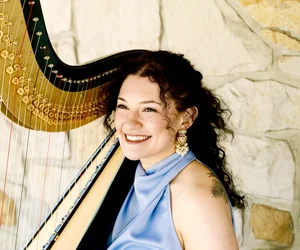
From a medical model, I have moderate to severe hearing loss and wear hearing aids. I also have vision loss significant enough that I cannot reliably read standard printed music from a stand. I also live with a chronic condition that causes vertigo, dizziness, and double vision. Listed this way, it sounds like a long list of things standing between me and the harp: I cannot always hear whether a note is in tune, I cannot see the strings without turning my head, and on a bad day the room will not hold still. That is the medical model's answer to “what is wrong.” It’s accurate, but its also nowhere near the whole picture.
Here is what happens when I ask instead how I access music: I feel the resonance of the strings through the soundboard against my body. I recognize the bass wire strings, gut strings, and nylon strings of my harp by their unique texture, size, and tension. The tactile feedback of plucking a string and my fingers closing into my palm gives me a sense of achievement that has nothing to do with what I heard.
I have sighted and hearing friends who also play the harp; they can sight-read from a stand, see the strings, and hear what they play. We play the same instrument. We access it through different bodies, but all of us are harpists.
A few places to start:
There is no single checklist that solves accessibility for every student, because every student and every studio are different. But a few adjustments tend to open doors quickly:
Electronic copies of music on a tablet, instead of paper, so a student can magnify, highlight, or adjust contrast on their own terms. Adjusting color/contrast, text size, and adding zoom/magnify - each one of these can be a gamechanger. All of these links are for iPad but every tablet has similar settings.
For printed music, color overlays can help make music notation more readable for students with dyslexia, dysgraphia, low vision, and some cognitive disabilities. My favorite ones are here (they cost less than $15!)
Rhythm and pattern-based teaching and improvisation, taught alongside or instead of standard notation (not just as a consolation prize for students who struggle with note reading).
Three (non-exhaustive) principles I keep close:
Assume every student can access music somehow. I have taught students with a wide range of diagnoses, and every one of them has found real enjoyment and achievement in music. If you cannot picture how a student might access music, that is a sign you have not yet asked the right question, not a sign it cannot be done.
Assume good intent, including your own. You will get things wrong sometimes. That is part of learning, not a reason to avoid trying.
Take care of yourself as you take care of your students. Redesigning how you teach takes real effort. Pace yourself the same way you would ask a student to pace themselves.
Where to go from here:
None of this is a formula that works for every student in every case. Instead, it’s a way of reconsidering how I teach music that I had to build, case by case, over years of teaching and years of living in my own disabled body. If you are not sure where to begin in your own teaching, that uncertainty is very normal.
I work with private music teachers to think through their specific students, their specific instrument, and their specific studio, to build a plan that can work. You do not have to figure this out alone!