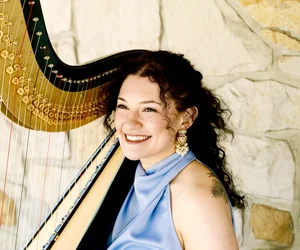
Strings Attached: How I learned (and re-learned) to play the harp
I’m peering out the frozen window of our back door, where an enormous cardboard box waits on the step. The snow has collected on the top of the box until it looks like it is wearing a white fluffy hat. It’s Christmas morning. I can barely wait until my mom stuffs me into my winter snow gear and jacket before I throw open the door and, with my brother’s help, drag the huge container inside the house.
I don’t know it - yet – but opening this box will start me on the longest, most rewarding adventure of my life.
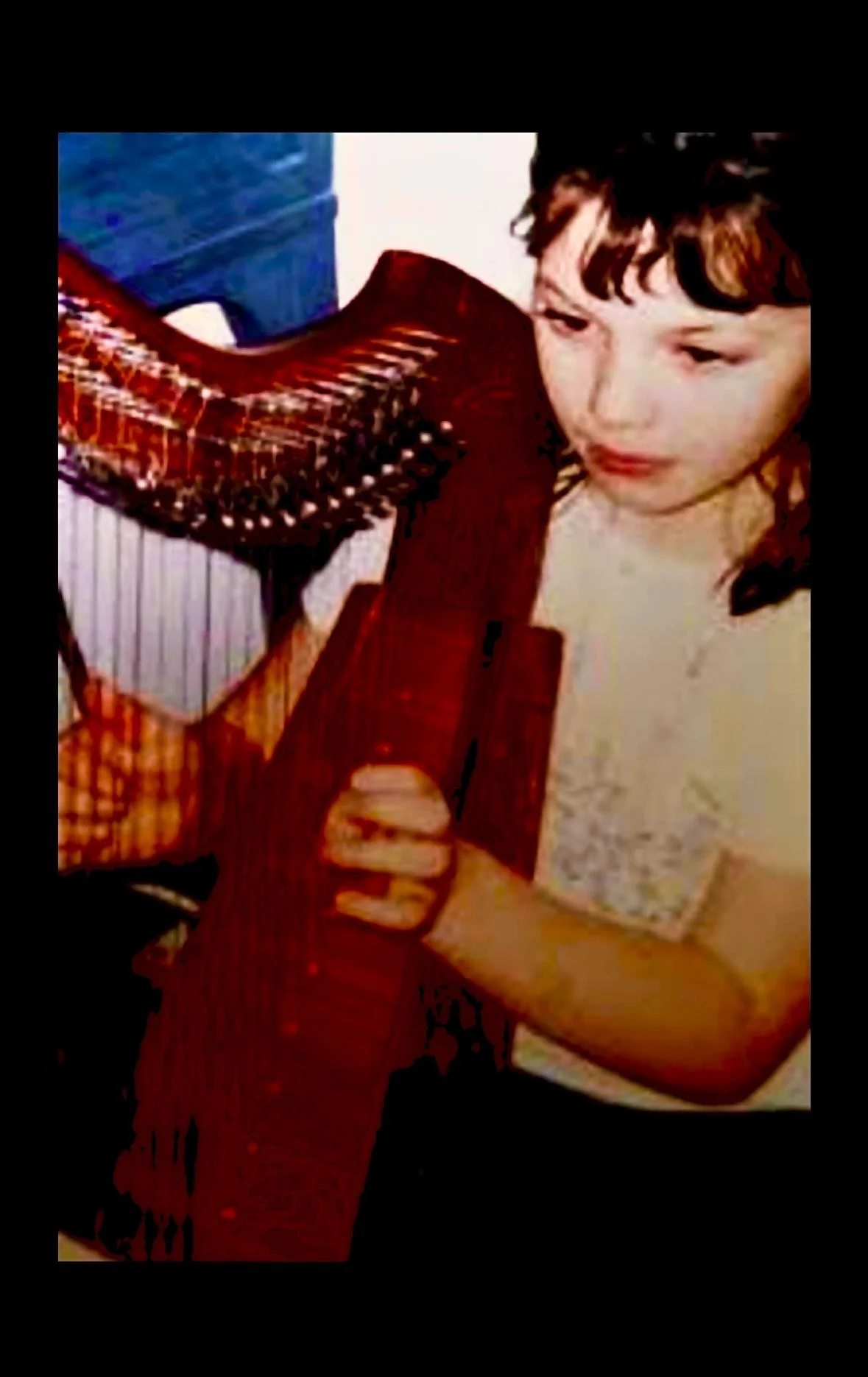
Playing my very first harp
No one in my family can agree about when or how I first learned about the harp. My mom says I saw a photo of a harp in a book. My siblings say I saw one on a field trip, or on a family vacation – they’re not quite sure. I don’t remember that first time, either, but some of my earliest memories include me begging my parents to buy me a harp when I was four years old. My parents caved, eventually. It wasn’t so much that I convinced them as much as I wore them down. In true y2k fashion, they found an unusually low price on a harp in a magazine and placed a mail order for that Christmas. The harp was tiny, 22 strings, and made in Pakistan (we think). I’m still surprised that for its poor-quality materials, the craftmanship of the instrument was so high that the instrument remains playable and in our family over 25 years later. The sound of it is not beautiful or remotely comparable to better-known brands of harp. But I still play it. My nieces still play it. It is a Christmas gift that keeps on giving year after year.
Over the years, my relationship with the harp has changed dramatically.
I first started playing that 22-string harp with eagerness and curiosity as a 5-year old. Although I had an occasional harp teacher and a few masterclasses, much of my early technique was self-taught. I leaned heavily on my much-more-rigorous piano instruction. My parents could only afford one music teacher at a time. I’m incredibly grateful for the gift of piano, because it was the vessel through which I learned music.
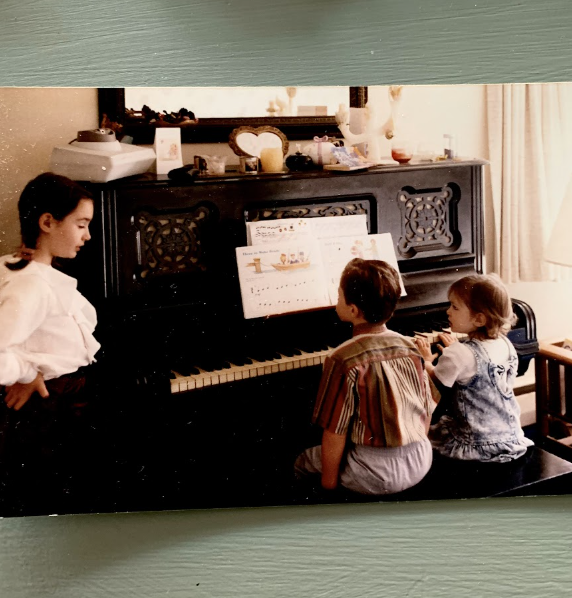
That’s me on the far right, getting an early lesson in note-reading from my sister (far left) and brother (middle)
I learned how to read music before I learned how to read books. I remained persistent in immediately applying everything I learned from piano directly to the harp. I learned my scales on the piano, then I taught myself them on the harp. I learned my inversions and arpeggios on the piano, then I taught myself them on the harp. Many skills transferred, much to my surprise and delight. Alongside these explorations, I checked out books and tapes and CDs from the library about harp and harpists. I read about the ancient history of the harp: the surviving depictions of various types of instruments across the globe from the earliest civilizations. I read about modern Western pedal harps and studied diagrams of their inside mechanics. As I listened to Rodrigo, Debussy, Castelnuovo-Tedesco, Ravel, and all my other favorite harp composers,
I dreamed about the day when I would have a gilded pedal harp of my own. I’d be the harpist, commanding the stage.
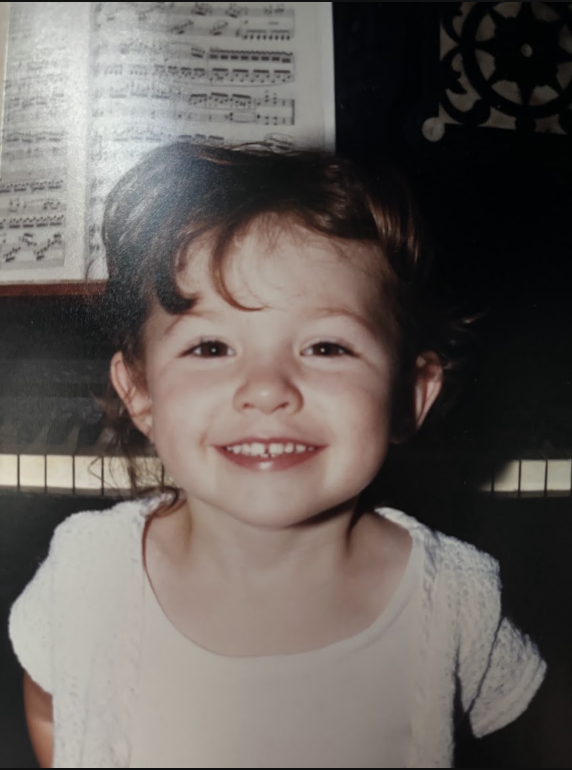
I really tried to be a good piano student, but my heart was always with the harp.
To make this dream a reality, I worked – literally. I got my first job - stamping envelopes for a neighbor - and saved (nearly) every dollar. Over a few years, I eventually saved around $7,000, and to my dismay, I realized that even this amount couldn’t buy a used pedal harp. Somehow, I struck a deal with my brother whereby he would lend me an extra $3,000 from his job earnings; in return, I promised to practice hard so I could get into his high school – an audition-only public school for the performing arts with a strong music program where he studied violin and viola. I’m not sure what inspired this selfless gift, but it’s safe to say that I wouldn’t be here today without it. Thank you forever, Josh ☺ With our pooled resources, I scoured used harp listings every day until I finally found a contender that was located in Upstate New York. We also lived in the Upstate… the Upstate of South Carolina, that is. I had a van and plan, though. My family and I drove some 18 hours to pick it up, a beautiful, sturdy Venus Baroque. The moment my fingers plucked the strings, I knew that harp and I were destined to do great things together. The elation I felt with a harp in the car – with MY harp in the car! – on the way back home is hard to describe.
The next step in my plan required finding a harp teacher who would take me on as a teenager who was primarily self-taught and hard of hearing.
This proved even more difficult. Two teachers told me that my dreams of playing the harp professionally were out of the question. Simply put, I didn’t have the preparation or potential - or the time to gain either of those things. This crushed me. I did need to re-learn the harp from scratch, and that would take time, but the teacher who eventually agreed to teach me acknowledged both reality – I was older than many students at my level, and I did have hearing impairment – and my dreams. She told me that the bridge between reality and dream was, again, hard work. My mom drove two hours each way so I could study with this teacher. We all worked. While it was clear that any outcome would be dependent on the effort I was willing to put in, the difference from the prior two teachers was her unashamed belief that I could actually make it. And I did.
I auditioned for conservatories – recording audition videos, preparing repertoire, and traveling around the country to give in-person auditions. I worked harder than I thought it was possible to work. I was accepted into five music schools and conservatories to study the harp. When I arrived at college, I was finally living the dream.
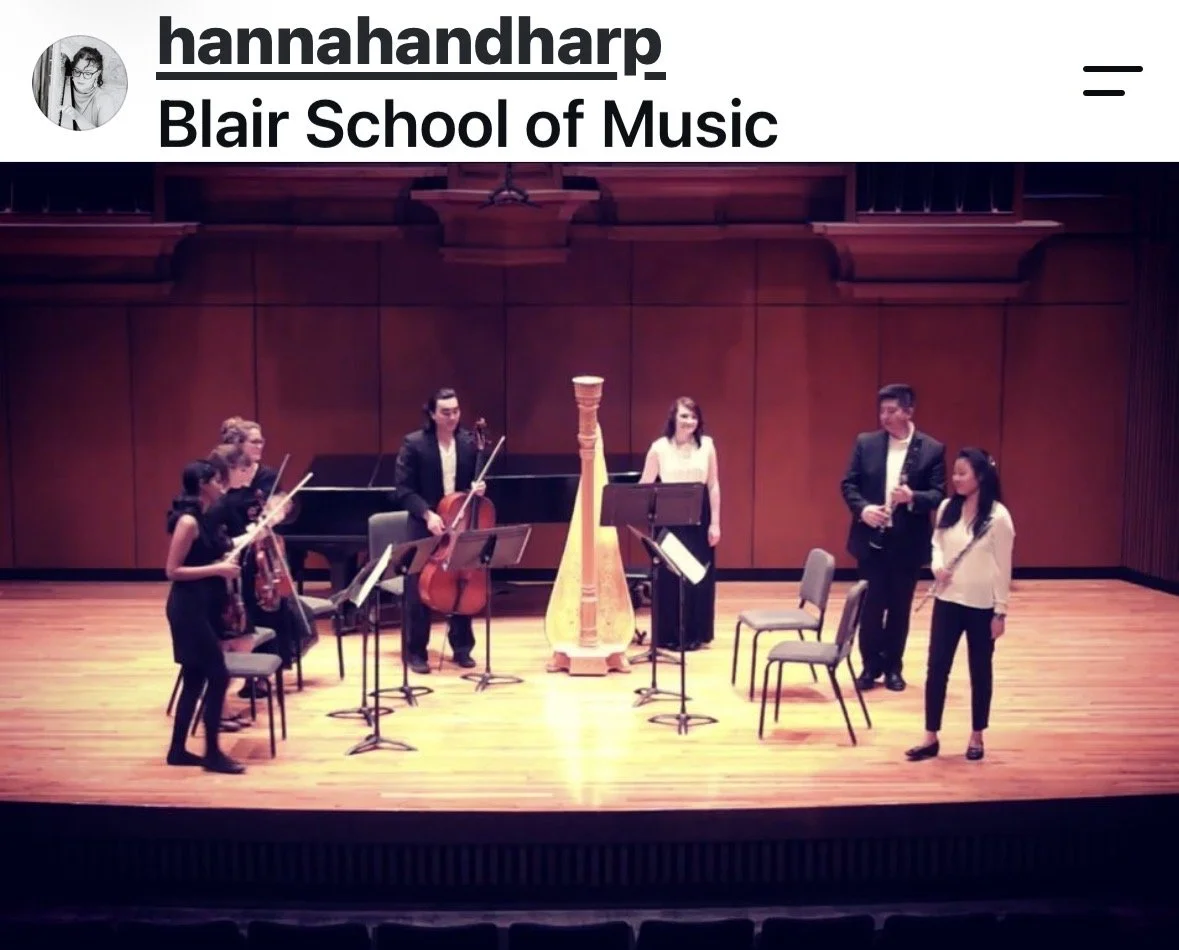
At long last, I was the harpist on the stage.
I was learning from a university professor who I adored. I was learning the Debussy, and the Ravel, and everything I imagined playing.
Then, the dream started to disappear.
One October night in sophomore year, I threw up on stage at an orchestra concert. I was hospitalized, then hospitalized again. My bones seared with pain. The skin on my fingers bled from the medications and the cuts on my left hand - from the wire bass strings of the harp - wouldn’t heal. I played a harp ensemble concert then left the stage to inject myself with yet more medications. My head ached, and I lost my hair. Slowly, the dream slipped from my fingers, even while they remained on the harp strings. I added a major in education out of both interest and desperation. I knew, without anyone telling me, that professional musicians needed their bodies to be healthy in order to be successful.
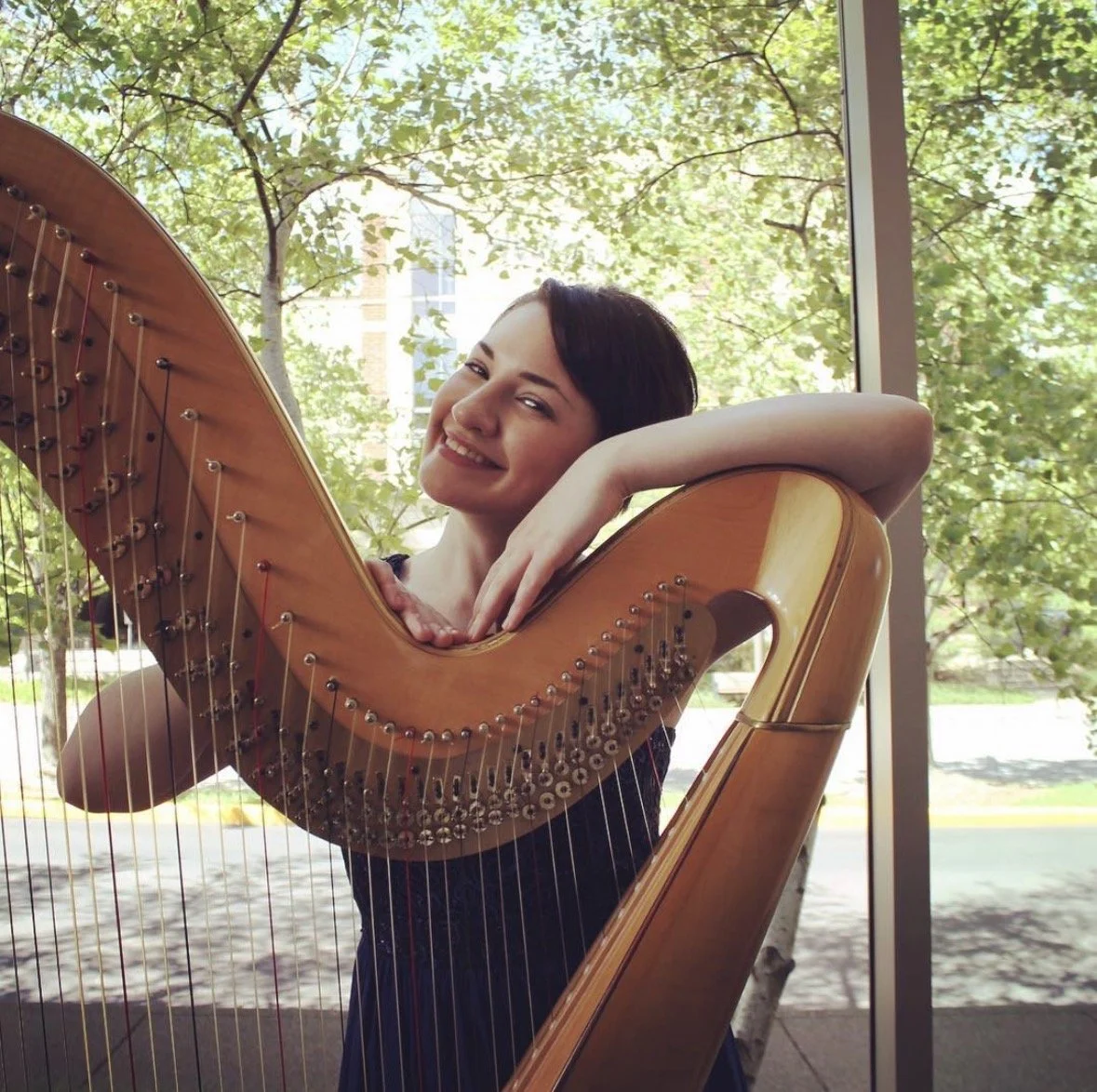
All the while, harp strings held me together, even with my professional hopes altered forever. I went into special education and learned a world of information that I still use to this day. This detour was, as is usually the case, an important step in the adventure. I kept on playing the harp. I started teaching students in our university pre-college program and combined my training in special education with my musical training by teaching harp to students with disabilities. I played for weddings and funerals and church services and gave a few solo and chamber recitals that I was – I am - so incredibly proud of.
Then, in my twenties, I started to lose my vision.
For a time, it was fine, and I denied that anything was happening. Then, one day, I put the music stand in front of my harp and sat back on the bench. I looked at the stand. I couldn’t see the stand. The black and white shapes on the page, which had been a constant my whole life before I could read English, were suddenly gone. I looked at the strings. They were gone. Just gone. I could see the dark blue F strings if I tilted my head and kept them in my left peripheral. But the harp goes on the right shoulder. There’s no way to see the strings in your left peripheral vision if the harp is on your right shoulder – believe me, I tried. I contemplated selling my beloved harp. I went months without playing.
This isn’t a heroic story of overcoming or discovering some latent talent. There wasn’t a momentous day when I simply sat down and decided I would play again. Instead, there were many ordinary days when I simply longed for the familiarity of the harp strings. I sat down at the harp and started to play, sometimes for only 5 or 10 minutes. At first I could only manage to play scales poorly. Then I played simple songs that I learned as a 5-year old. Then I remembered pieces from my college studies - Un Sospiro by Liszt, Rhapsodie by Grandjany, Rodrigo’s Concierto Serenata - and was amazed that after so many years, they still felt amazing in my hands.
Somewhere along the way, I taught myself to play the harp, again.
Now, I play my harp everyday. I’ve learned hundreds of jazz, pop, modern, and Classical pieces. Right now, I’m learning the basics of South Indian Carnatic music from a (very patient) musician friend.
I still feel like a beginner.
When I sit down at my harp today, I still think, I can’t believe I get to do this.
I was told - implicitly and explicitly - that hard work is the ticket to living out my dreams. But now I wonder if the hard work is just the surface. All along, beneath the hours of practicing and working, the strings keeping me attached to the harp were curiosity, awe, and creativity. I don't think this is really a story about the harp. Or maybe it is, but only because the harp happened to be the thing I loved first, and so it became the thing I kept returning to when I was five and when I was fifteen and when I was twenty-five and now. I wonder what it might have been for you: a violin in the closet at your parent’s house? A pair of ballet shoes at the bottom of a bin? Somewhere along the way, most of us set something down, not because we stopped loving it, but because life took a detour: a job, an illness, a version of ourselves we had to become to survive. What if the way back to that dream isn’t just more hard work or obligation? What if the strings tugging you back are actually excitement, joy, and curiosity? I know what it feels like to pick something up as a total beginner - fingers clumsy, memory faulty, and ego fairly bruised.
Does re-learning a passion as an adolescent or adult feel a little bit humiliating? Sure, it can. But I also think, if my harp has taught me anything, revisiting something you love might feel a tiny bit like opening a box on Christmas morning.